DOCUMENTARY, ARTICLE
Who Was Elie Wiesel? The Life Behind ‘The Survivor in a Tuxedo’
Before he was a Nobel laureate, he was a 15-year-old boy from a small town in Transylvania. Here’s the story of the man Presidents called “the conscience of the world.”
From Sighet to Auschwitz
Elie Wiesel was born on September 30, 1928, in Sighet, a town then controlled by Hungary (now part of Romania). He grew up in a Hasidic Jewish community devoted to prayer and religious study. That life was shattered in May 1944, when Sighet’s Jewish population, including Wiesel, his parents, and his youngest sister, Tzipora, was deported to Auschwitz. (Source: Britannica; EBSCO Research Starters)
At Auschwitz, Wiesel’s mother and younger sister were killed. He and his father were later transferred together to the Buna Werke labor camp, a sub-camp of Auschwitz III-Monowitz, and eventually to Buchenwald, where his father died of starvation and illness just weeks before the camp was liberated in April 1945. Of his immediate family, only Wiesel and his two older sisters survived. (Source: The Elie Wiesel Foundation; Biography.com)
The Silence, and the Book That Broke It
After liberation, Wiesel was sent to France, where he studied at the Sorbonne and worked as a journalist and translator. For years, he refused to write about what he had witnessed, doubting he could ever convey the truth of it. That changed in the mid-1950s, after an encounter with the Nobel Prize–winning French novelist François Mauriac, who urged him to break his silence and “bear witness” for those who could no longer speak. (Source: Chicago Public Library)
The result was Night, first published in French as La Nuit in 1958, a memoir of his year in Auschwitz and Buchenwald. It has since become one of the most widely read works of Holocaust literature in the world. (Source: Nobel Prize official biography; United States Holocaust Memorial Museum)
Becoming “The Conscience of the World”
Wiesel went on to write nearly thirty books, teach at Boston University and the City College of New York, and chair the United States Holocaust Memorial Council, where he helped drive the creation of the U.S. Holocaust Memorial Museum. (Source: USHMM; Nobel Prize official biography)
But he didn’t stop at remembrance. Wiesel became one of the world’s most outspoken defenders of human rights, speaking out for Soviet Jews, Nicaragua’s Miskito Indians, Argentina’s “disappeared,” Cambodian refugees, the Kurds, victims of apartheid in South Africa, famine victims across Africa, and those caught in the wars of the former Yugoslavia. (Source: Chicago Public Library)
In 1986, that lifetime of advocacy earned him the Nobel Peace Prize. In presenting the award, Egil Aarvik, chair of the Nobel Committee, said Wiesel’s mission was not simply to gain sympathy for survivors, it was to “awaken our conscience.” (Source: Chicago Public Library)
In his Nobel acceptance speech, Wiesel put it simply:
“We must speak, we must take sides, for neutrality helps the oppressor — never the victim.” (Source: NBC News)
A Legacy That Outlived Him
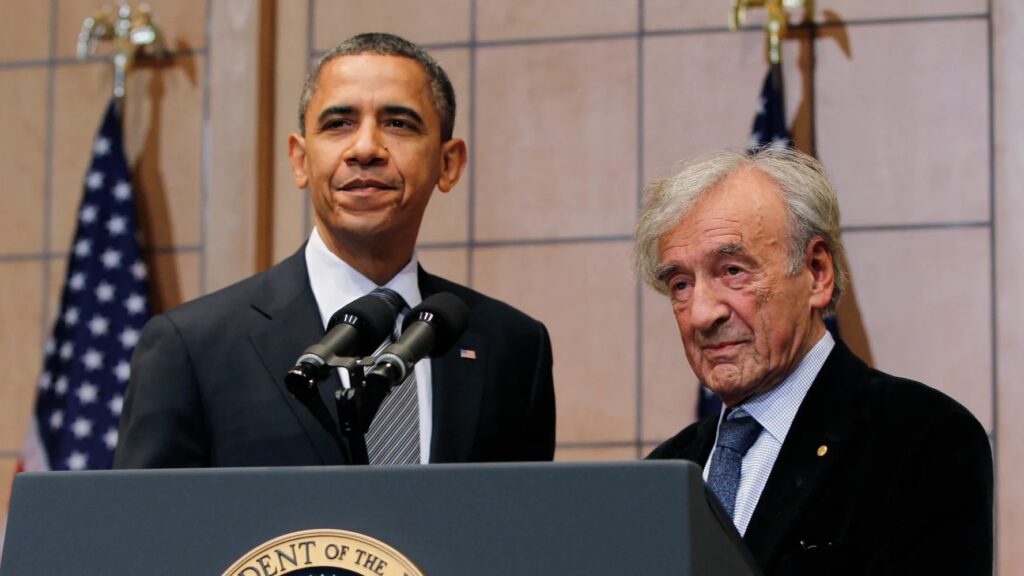
Elie Wiesel died in New York on July 2, 2016, at the age of 87. President Barack Obama called him “one of the great moral voices of our time, and in many ways, the conscience of the world.” (Source: Fox News)
It’s that gap, between the 28-year-old survivor who privately hoped one day to win a Nobel Prize for literature, and the man who decades later won it for peace, that sits at the heart of THE SURVIVOR IN A TUXEDO.
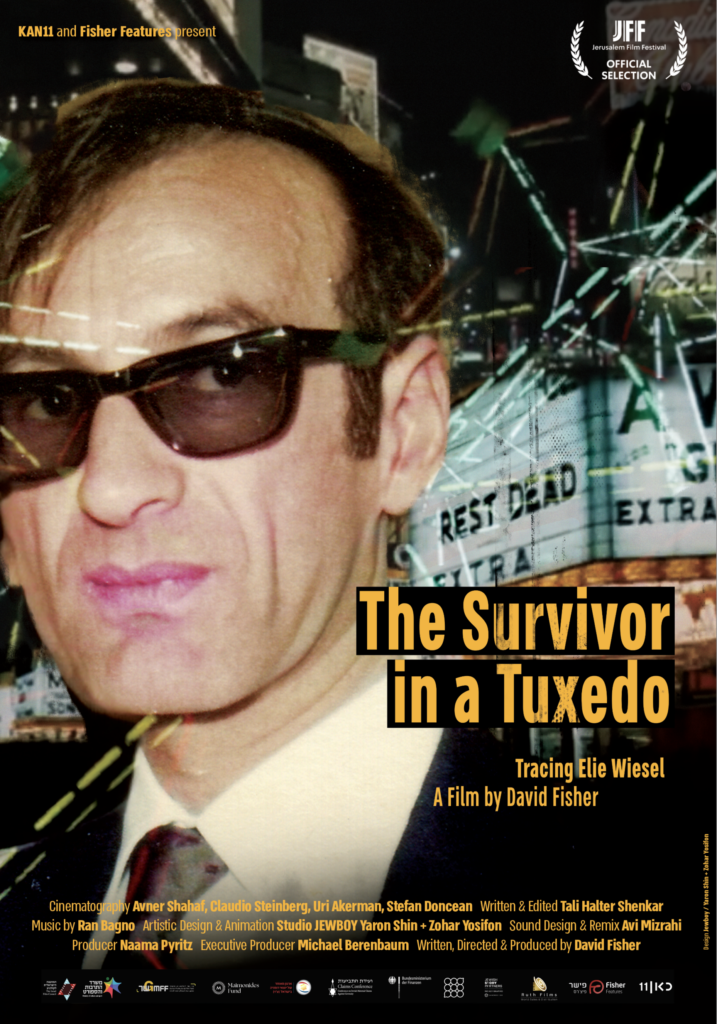
At 28, Elie Wiesel revealed his ambition to win the Nobel Prize for Literature for Night, written after his liberation from the camps. Decades later, he did win the Nobel — for Peace. In that gap he lived his entire life. Wiesel became the conscience of the free world — wearing his survival like a tuxedo over the prisoner’s uniform he could never part with. The filmmaker, whose father was deported on the same train to Auschwitz as Wiesel, sets out on a personal investigation believing that important figures deserve more than reverence — they deserve the truth.